

Marketing has chased one goal for more than a century: proving exactly which dollar created which result. John Wanamaker captured it simply when he said, ‘Half the money I spend on advertising is wasted; the trouble is I don’t know which half.’ More than 100 years after Wanamaker’s quote, most firms still cannot answer the question of which half of their marketing works.
I’ve recently solved this century-old problem using AI, and in this article, I’ll show you how.
What Is the 100-Year Marketing Problem?
The Holy Grail in marketing has always been revenue attribution — linking every dollar of revenue to a specific marketing channel or lead source.
Despite moving from newspapers and radio to Google Ads, SEO and analytics, most firms still cannot answer the critical question: Which dollar spent produced which dollar of revenue?
‘Digital marketing promised to fix the problem with tracking codes, pixels and cookies. It didn’t, because humans were still required to join the marketing data with the revenue data.’
Receptionists must ask how someone found the firm. Lawyers must choose lead sources in their CRM. Neither happens consistently.
‘Clients forget. Staff get busy. Lawyers focus on legal work, not admin. As a result, firms work with incomplete or inaccurate data.’
Wanamaker’s problem survived for a century because attribution depended on people. That is the part we removed.
The Solution: Removing Human Error
Most firms have software that records generic sources like ‘Google’ or ‘Word of Mouth’, but the client’s real journey is often more complex. Someone might see a LinkedIn video, click a Google ad weeks later, search your name and finally call.
‘Human reporting never captures this accurately.’
By using AI to connect marketing data with revenue data, the loop finally closes. The system tracks every dollar back to its source without relying on receptionists, clients or lawyers. It simply does the work humans don’t do consistently.
(Image placeholder: intake lead tracking view)
How Attribution Breaks Inside a Law Firm
Every firm operates with two disconnected truths:
The marketing truth
Clicks, calls, forms, ads, videos, search terms. All the digital fingerprints show how someone reached you.
The financial truth
Invoices, trust receipts, and matter data. Revenue recorded in Xero, Clio, Smokeball or LEAP.
These systems rarely communicate. Firms see fragments like ‘Google’ or ‘Referral’, even though the real path is multi-step. By the time the client speaks to reception, they say, ‘I found you online.’
‘This disconnect is the core of the hundred-year problem.’
The Marketing Truth: Intake Lead Tracking
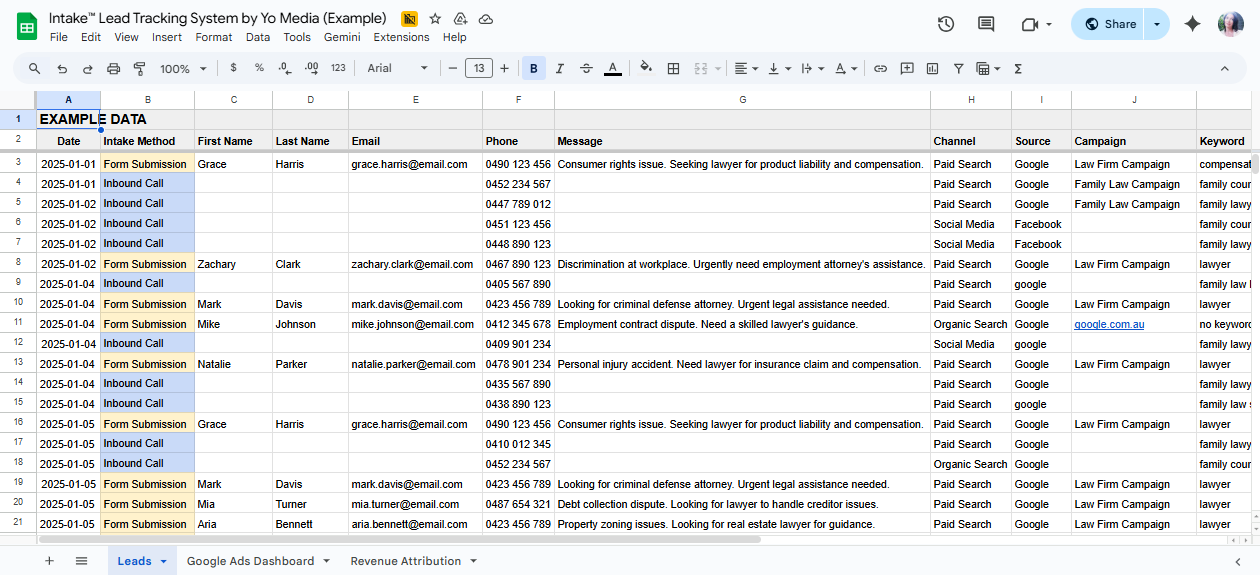
The intake tracking view looks simple, but it contains powerful data.
Most firms store:
• Marketing data: clicks, ads, and lead sources
• Invoicing data: client names and fees paid
But the two systems never link.
On the left side of the dashboard is the Marketing Truth. Using Grace Harris as an example, we know she submitted a form about a consumer rights issue. We can see she came from Paid Search via a specific campaign targeting ‘compensation lawyer’. We track both the landing page and the submission page.
The same precision applies to calls. The system captures the source, keyword and campaign, and stores the recording for lead quality review.
The Importance of Speed to Lead
The system also tracks calendar bookings, which are essential. Industry research consistently shows that responding within minutes dramatically improves conversion rates.
Speed to lead determines who wins the client. If you don’t call back immediately, potential clients move on.
‘In most cases, the first firm to respond wins. Many firms take hours.’
For after-hours enquiries, bookings take the client off the market. If someone secures a 9.00 AM appointment, they stop searching because their next step is already set.
The Financial Truth: Automating Attribution
Now we look at the Financial Truth.
Grace Harris ultimately generated $16,500. In the past, clients were asked to update spreadsheets or CRM fields. They rarely did. The data remained incomplete.
We solved this by pulling data directly from the billing software. When the system sees that ‘Grace Harris’ paid $16,500, the AI matches her details to the lead data, confirms she came from Paid Search, and attributes the revenue automatically. Her matter status updates to ‘Open File’ instantly.
This removes human involvement and delivers reliable accuracy.
(Dashboard)
The Revenue Attribution Dashboard
Once automated, the system generates a dashboard that displays the exact revenue generated by each channel.
Example data
Paid Search
• 72 clients
• 26 % conversion
• $794,545 revenue
• $11,000 average matter value
• 18-day conversion time
Referrals
• Higher conversion
• Nearly $350,000 in revenue
• 12-day conversion time
SEO tends to take longer, around 22 days, but drives strong long-term revenue.
‘This means it’s no longer guesswork or gut feeling. It is your bank account organised by marketing source.’
Staff change nothing about their workflow. The system does the matching automatically using digital fingerprints like emails, phone numbers and IP addresses.
Campaign Optimisation and ROI
Once attribution is accurate, you can track campaign performance against targets and measure revenue, not just leads.
A practical example
A client allocated $5,000 for a monthly campaign. Based on performance, we expected around 10 matters.
In April:
• Spend: $5,080
• Visitors: 550
• Leads: 59
• New clients: 15
• Revenue: $159,000
This produced a 31 times return on ad spend. Every $1 generated $31.40.
Diagnosing issues
When the cost per lead rises, the system reveals why. In one case, low landing page conversion (3 %) was the problem. After improvements, conversion reached 10 % and lead costs fell.
This clarity lets firms adjust underperforming campaigns and scale the ones delivering the strongest revenue.
What Would Change If You Knew the Truth About Your Marketing?
The technology to solve your problem already exists, and the data you need is already inside your firm. All we do is connect the two wires. In every implementation, firms uncover realities they had never seen before. Some learned that their SEO was quietly driving major revenue. Others realised entire channels were underperforming. The difference is that now they can act on the truth.
If you want to see exactly how much revenue each marketing channel generates in your firm, book a free attribution audit with me. I will plug in your data, run the match and show you your own Holy Grail table. Once you see where your revenue truly comes from, you will never look at marketing the same way again.